A kid enters a room containing several toys and starts playing with a red truck. If we now put a second kid in the room which toy will they want?
You don't have to be a parent to know the answer. The red truck, of course.
I've asked this question to people for years and the answer is the same. We instinctively understand that the first child's choice changes how the second child perceives the choices available. It seems to be a fundamentally human pattern, and the red truck's stock got rerated higher as a result.
Now think about red trucks in the grown-up playroom known as the capital markets. There are a lot more toys in this toybox in the forms of stocks, ETFs, real estate or private credit, to name a few. The pattern doesn't change: everyone wants what everyone else seems to want.
Sophisticated investors have been exploiting this pattern since money was a thing.
To that end, a recent HindeSight investor letter, A Credit Cycle Wearing AI's Costume, channels the work of and . For anyone interested in investing, it's a must-read, sophisticated financial analysis that applies red truck thinking to the AI investment boom, explaining how expectations, capital, and earnings can feed back into one another and still fracture while the technology hugely benefits organisations and the local economy.
It also holds insights for those folks tasked with implementing AI in their organisations, and this article has been written for the latter folks.
Reflexivity and Watching Red Trucks
George Soros, the Hungarian-American investor who made his fortune through currency speculation, developed the theory of reflexivity: market participants' biases and perceptions influence asset prices, which in turn influence reality. When everyone watches everyone else watching the red truck, the observation changes what the truck means.
Hyman Minsky
American economist who developed theories about financial instability and the cyclical nature of credit in capitalist economies. His work explains how periods of stability paradoxically sow the seeds of instability, and how credit cycles can lead to financial crises.
Not all of us are investors. But our decisions, trade-offs and what we optimise for the benefit of our organisations, ripple outward. My prior articles cover examples of our experiences at TSG of , and , and what this means while . This article connects those signals to the concepts covered in the HindeSight letter, to the practical reality of decisions many of us are making today.
Productivity
Six months of work became four to six years of output. That's real. But who actually captures that value when software becomes cheaper and smaller companies can do what enterprises used to need?
Read the full article →Buy versus Build Economics
We built our own CRM for almost nothing. The company trying to sell you one borrowed heavily, and now the bond market is repricing that bet. What happens to SaaS when financing gets expensive?
Read the full article →Optimisation
When bandwidth became expensive, customers cached it and stopped buying repeatedly. Now organisations are doing the same with AI: caching, routing between providers, running models locally instead of premium frontier every time. How much of the growth projections disappear when customers optimise?
Read the full article →Rising Cost of Capital
Three per cent Treasuries change the financing math. A datacentre that was worth building at 5.5 per cent borrowing cost becomes uneconomical at 7.5 per cent. And the same happens to the valuations of the companies using it. This is where reflexivity reverses.
The US thirty year Treasury passed 5.3% in late August 2026, its highest since 2007. Japan's ten year reached 3% for the first time since 1996. The UK thirty year gilt hit 5.89%, last seen in March 1998, with the ten year above where it sat during the financial crisis. Germany's thirty year is at its highest since 2011.
Not one of those numbers is about AI. Deficits, inflation, and most recently energy prices after the strikes around the Strait of Hormuz.
Which is rather the point. The price of money is being set somewhere else entirely, by people who are not thinking about datacentres at all.
CNBC, September 2026 →Reflexivity and Watching Red Trucks
Soros applied the red truck phenomena to markets and called it reflexivity. Markets have one essential difference from two toddlers in a death grip for a toy: shelling out cash is involved.
- An observer forms a belief (the second kid decides the truck is the good one)
- The belief drives action (they go for it)
- The action changes reality (the truck really does become scarce and contested)
- The changed reality confirms the belief (it really is the best toy in the room now, and wait till a third kid walks in)
Here's the AI trade version.
- Investors believe AI will drive enormous value
- The belief lifts prices and makes capital cheap for "AI exposed" companies
- That capital gets spent: datacentres get built, models get trained, capability genuinely improves
- The improvement reads as proof the belief was right, and more capital arrives
Soros's insight is that causation runs both ways.
- Good prospects lift a share price, which lets the company raise capital cheaply, hire hard and acquire, genuinely improving prospects.
- A falling price makes capital expensive, forcing ambitions to be curtailed, which genuinely worsens prospects.
None of this means the red truck is a bad toy. It means the observation changed the thing being observed.
You might read Soros and think that is just virtuous cycles and doom loops with a cheque-book and philosopher attached, and you would be largely right. Minsky, on the other hand, cared more about who signs the cheques.
Who's Paying for the Red Truck?
Minsky's argument was that , which sounds like a paradox unless you have lived with a heavily customised SharePoint solution.
What Minsky actually wrote
The line usually put in his mouth, "stability breeds instability", appears nowhere in the paper where he set the argument out. What he wrote was drier and more useful.
His second theorem: "over periods of prolonged prosperity, the economy transits from financial relations that make for a stable system to financial relations that make for an unstable system." Over a long run of good times, an economy drifts from hedge finance towards speculative and Ponzi finance.
The part worth holding onto is what he says next. The hypothesis "does not rely upon exogenous shocks to generate business cycles of varying severity." Nothing has to arrive from outside. The system does it to itself, which is why the financing can fracture while the technology carries on working.
Hyman P. Minsky, The Financial Instability Hypothesis, Working Paper No. 74, The Jerome Levy Economics Institute of Bard College, May 1992.
Read the paper →ticks all the initial boxes. Already licensed, already deployed, and already supported. So we build: A team site becomes a document register. Lists get used for structured data. Workflows emerge and grow in scope. Web parts get written because the out of the box ones don't cut it.
Every step is reasonable because the last one worked, and the stability is precisely what earns it the workload.
And because it's the core platform, we keep building on it. Ambition grows and with it complexity grows, yet technical debt has been accumulating.
Then we have our , where InfoPath and SharePoint Designer get . Nothing immediately breaks: Microsoft has simply changed a roadmap. But every form and workflow now has an end date. Rebuilding one means decoding web parts nobody can explain and lifting data out of lists that were never a database. Replacing a form has become an expensive data remediation project.
A phrase Minsky never used
Paul McCulley, then running bond funds at PIMCO, coined it in 1998 to describe the Russian debt default. Minsky had been dead two years. McCulley gave us "shadow banking system" too, and both phrases went mainstream in 2008.
It names the moment the calm ends. Positions that only worked while asset prices held up have to be sold to cover the debt, the selling pushes prices down, and the lower prices force somebody else to sell. The trigger is usually mundane. What makes it expensive is everything that was quietly loaded on beforehand.
A Perspective on Minsky Moments →Deprecated
A vendor announcing that something still works but is on its way out. No new features, a date when support stops, and a migration nobody scheduled. Nothing has failed and nobody has done anything wrong.
InfoPath was how you built forms, until it wasn't. SharePoint Designer was how you built workflows, until it wasn't. Neither stopped working on the day it was deprecated. Both simply acquired an end date, and with it a rebuild.
And you do not just port the thing across, you pick a successor. Today that means choosing between Power Automate and Copilot Studio, and reasonable people are choosing differently. Whichever you pick, you are making the bet the InfoPath team made, on the same evidence: it is what Microsoft is recommending right now.
You never repay this debt. You refinance it, on whatever terms are going at the time.
Now Minsky was a SharePoint guy. Apart from being dead since 1996, he was an economist, so the subject was lending money, but the shape is the same.
He never had the chance
He died that October. SharePoint Portal Server shipped in March 2001, so he missed it by a little over four years and had no opportunity to form a view.
Whether that makes him lucky is left to the reader.
A lender who has not been burned in years writes easier terms, a borrower whose last loan worked out takes a larger one, and the safeguards nobody has needed get quietly trimmed. In safety parlance, this is called : skipping the check becomes normal because nothing went wrong the last time you skipped it.
Normalisation of deviance
The sociologist Diane Vaughan named it in her 1996 study of the Challenger launch decision. Engineers had been seeing O-ring erosion on earlier flights for years. Each time, the shuttle came back. So the erosion stopped being a warning and became an expected finding, something you noted and flew anyway.
Her argument was that this was not recklessness and not a cover-up. It was a slow collective slide in which a departure from the safe standard quietly became the standard, one uneventful flight at a time. The Columbia board reached for the same idea in 2003.
The tell never changes. The evidence that the risk is acceptable is that nothing has gone wrong yet.
So how do you tell how far a particular arrangement has drifted? Minsky teaches us to consider the reflexive story in light of what the cash coming in actually covers. There are three answers, and each one leans harder on somebody else.
- Hedge finance. The cash covers interest and principal. The thing pays for itself and nobody has to be asked for anything. Boring, and boring is good.
- Speculative finance. The cash covers interest but not principal, so the debt has to be rolled over. The demand can be entirely real. The financing still depends on somebody agreeing to refinance it.
- Ponzi finance. The cash covers neither. It works only if asset prices keep rising, or more capital arrives, or somebody buys the whole thing at a higher number.
If you flinched at the word Ponzi, you did exactly what Minsky intended. He was not accusing anyone of Charles Ponzi-esque fraud. In fact a Ponzi structure needs no grand schemer pulling the strings. The question is whether tomorrow's optimism is required to meet today's obligations, and that answer can change while the asset does not. The datacentre is the same datacentre. What moves is the financing wrapped around it.
Minsky Is Definitely a Datacentre Guy
I won't rehash too much detail about AI capex numbers, the circular deals, hyperscalers funding model companies that buy compute back from those same hyperscalers, because it's old news. The point is that as I type this, everyone in the reflexive chain can point at the next participant as evidence of demand, and none of them are lying.
But let's put our freshly minted Minsky hat on. This all used to be funded out of hyperscaler operating cash flow, which if you recall is his boring yet safe funding approach. It is increasingly funded with : bonds, private credit, lease structures and that hold the borrowing at arm's length.
Special purpose vehicles
A separate company created to do exactly one thing. Here, to own a datacentre and carry the loan that built it. The developer sets it up, the lenders lend to it, and the borrowing sits on its books rather than on the balance sheet of whoever stands behind it.
There is nothing improper about this. Project finance has worked this way for decades, and ring-fencing a single asset genuinely does contain the risk of that asset.
Leases work the same way for a different reason. Microsoft's 2026 annual filing discloses 329.1 billion dollars of leases that have not yet commenced, up from 196.6 billion three months earlier. They begin between financial years 2027 and 2033, and until the payments start none of it is a balance sheet liability.
What it changes is visibility. The debt is real and somebody is on the hook for it, but you will not find it by reading the parent's balance sheet.
Microsoft FY2026 10-K, July 2026 →Where the cash flow went
Alphabet went free cash flow negative in the second quarter of 2026, the first time since it listed in 2004, burning 5.9 billion dollars against 44.9 billion of capital expenditure. Amazon slipped negative in the same period.
Oracle closed its 2026 financial year at negative 23.7 billion, with 32 billion of operating cash flow against 55.7 billion of capex, up 162 per cent on the prior year and 5.7 billion beyond its own guidance. Meta's free cash flow fell 91 per cent, it issued 55 billion of debt and it stopped buying back its own shares.
Of the American hyperscalers, Microsoft is the last one still generating positive free cash flow. Aggregate capex across the group is on track to pass aggregate operating cash flow around the third quarter of 2026, which is to say now.
Figures from market reporting rather than from us, and worth checking against the filings before you repeat them.
FactSet Insight →Where the money is coming from now
The major hyperscalers issued roughly $220 billion of US corporate bonds in 2026 alone. The figure for the whole of 2025 was $121 billion, and the average between 2020 and 2024 was about $28 billion a year.
Moody's puts direct debt across Microsoft, Amazon, Alphabet, Meta, Oracle and CoreWeave at around $460 billion, with roughly $1.2 trillion of lease commitments on top. Private placement issuance, the format insurers favour because they hold to maturity rather than trade, reached about $81 billion in the first five months of 2026, the highest for that period since the data begins in 2016, with AI and datacentre financing named as the driver.
Spreads have widened at every maturity. Around 40 basis points over Treasuries at two to four years, up from 30 in 2025. About 60 at five to seven. Roughly 118 beyond twenty years. None of that is distress pricing. It is the market asking to be paid more for financing something this size.
Figures from the HindeSight letter, which sets them out at length.
Nobody took a decision to move down Minsky's staircase. It was a natural progression of reflexivity.
A hyperscaler leases infrastructure that does not exist yet, the developer borrows against that promise to build it, and the loan is on-sold to pension funds and insurers who collect the interest. Each new raise is a reasonable response to the last financing vehicle being snapped up while the positive reflexive loop remains intact.
This em dash is mine
Em dashes have become a tell for machine-written prose, so there are none anywhere else in this article. That was deliberate, and so is this one.
It was typed by a human being with an opinion about punctuation, and I would like the credit.
While the Positive Reflexive Loop Remains Intact…
The AI reflexivity loop we've been examining absolutely walloped a prior reflexivity loop not too long ago. I am of course talking about the . It benefited for years from its own loop, which looked like this.
Then the AI loop cut straight through it, not by beating anyone on features, but by flipping the economics of "buy vs build".
The selloff was brutal for impacted companies because their earnings multiples were rerated accordingly. While things might have blown over in terms of media coverage, as I type these lines many need to gain to get back to their 2025 highs.
Why a third down needs a half back
Recovering from a fall takes a bigger gain than the fall itself, because the gain works off the smaller number. Down thirty per cent needs forty three to get level. Down a third needs forty nine.
The software sector ETF sits about thirty per cent below its September 2025 peak, with Salesforce, Adobe and Workday in the same band. ServiceNow, Intuit and Figma need considerably more, so the range above understates the tail rather than overstating it.
Figures from market reporting rather than from us.
24/7 Wall St on the named stocks →There is a lesson here that Soros and Minsky both understate. A reflexive loop does not only end by collapsing under its own weight. Another loop can end it, and maybe it is us.
The SaaSpocalypse
Early February 2026. Reports put the first 48 hours at around 285 billion dollars of lost market capitalisation, the week at over a trillion, and the preceding twelve months at roughly two trillion. Forward price to earnings on software went from about 84 times at the 2020 to 2022 peak to the low twenties by March, dropping under the S&P 500 multiple.
The proximate cause was a model release. Agents that could draft the document, build the workbook and run the multi-step process directly, rather than inside somebody's product, at a fraction of the seat price.
Seven months on it is half unwound. SaaS gained 18.9 per cent across the June quarter against 14.9 for the S&P, and enterprise value against 2026 revenue recovered from about 3.9 times to 4.7. Both numbers are a long way under where they started.
Which is the shape this article keeps describing. The revenue was real. The multiple was real. What changed was that the thing underneath them became visible, and it was visible to everybody at once.
Forbes, February 2026 →What We Have Actually Been Doing
If AI gains were imaginary, somebody would have noticed by now. If anything, most of the chatter is about a) shock and dismay when the bill arrives and b) governing the use of agents and the organisational data landscape they derive insights from.
Personally, I feel that in the last six months I've produced somewhere between four and six years' . Small companies now build systems that used to need an enterprise budget, and is one of them. That is not a forecast about what AI might one day do. It is a description of what happened, and we are with a version of it.
Not the only one
JetBrains surveyed more than 15,000 professional developers between May and July 2026. Ninety per cent use AI coding agents at work every week. Sixty-eight per cent use them daily. So no, not the only one.
The more interesting number is the churn underneath. Claude Code at 39 per cent globally and 47 in the United States. Codex at 16, up from 3 in January. Copilot down from 29 to 21. That is half a year.
Which is the refinancing problem arriving early. Whatever you standardised on in January is not what the team is using now, and the thing you pick today has roughly the same shelf life.
JetBrains sells developer tooling, including its own AI. The adoption totals are not the part they need to be true.
JetBrains research, August 2026 →Half of it goes straight back out
Yegor Denisov-Blanch and his group at Stanford have been measuring this against millions of commits from more than 100,000 engineers. Their finding is not that the gains are imaginary. It is that roughly half of them are eaten by rework: fixing what the model got wrong, unpicking logic it invented, making it match conventions it never knew about.
Net, they land somewhere around 15 to 20 per cent. Greenfield work at low complexity does far better, 30 to 40. The gains shrink as the codebase gets older, more tangled and less documented.
Which means the gains are smallest exactly where the last section was set. A heavily customised platform full of undocumented assumptions and dependencies nobody can name is the worst case for this, and it is also the most common one.
They avoid the word productivity, preferring developer output, on the grounds that what counts is what actually ships. Which is the same distinction this article keeps making about revenue.
Stanford Software Engineering Productivity research →TSG Backoffice
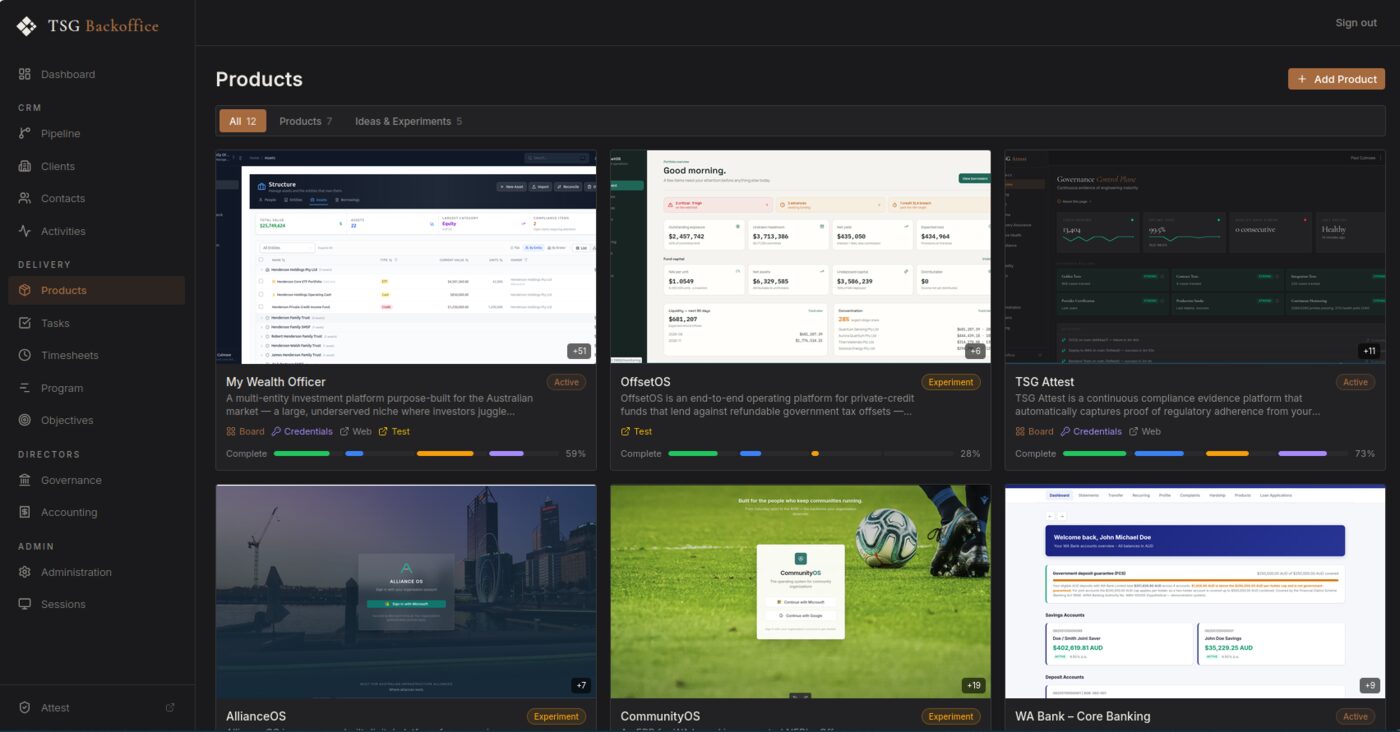
It started as a CRM and did not stop there. Pipeline, clients and contacts, then delivery, timesheets, objectives, governance and accounting. We run the company on it, and the screen above is where we run the product portfolio. Twelve of them, one of which is a core banking platform.
The interesting part is not that it works. It is what it cost. No vendor selection, no licences, no implementation partner, no integration project, and no decade spent inside somebody else's architectural compromises.
Which is the whole argument in one object. The value is obvious and it is ours. None of it shows up as revenue for anybody who is currently being financed to build AI infrastructure.
And it compounds. We did not simply get faster once. Every product we make leaves behind components, patterns, plumbing and hard-won decisions that the next one starts from. My Wealth Officer taught us the entity and asset model. The advisory platform took that and added the advice layer. Treasury took the ledger and added risk management. WA Bank added capability that satisfies a prudential regulator, which in turn was added into Treasury.
Each platform in our portfolio cost less than the one before it.

The other side of the ledger is delivering tools like this while optimising cost and lowering risk, and that habit is than any of this. Accordingly, we have been building a control plane, optimising our workflows, agent use and design of our products not only to reduce waste but to embed Australian prudential compliance into our DNA.
WiredCity, twenty-five years ago
Back then the bill that mattered was external bandwidth, and we answered it with three things. A proxy, so that ten requests for the same page bought that page once. Peering, so traffic between Australian networks stayed here instead of going out through a carrier that charged for it. And policy, so the cheap work stopped eating the expensive capacity.
None of it was clever. It was arithmetic, and it is the same arithmetic now that somebody has put a meter on intelligence. Cache what does not change. Keep local what does not need to leave. Stop paying frontier prices for work a smaller model finishes.
AI Is Approaching Its Proxy-Server Moment →Organisations everywhere are doing versions of the same thing. They cache stable answers, reuse document extraction, route work between providers, run suitable models locally and reserve frontier intelligence for genuine uncertainty. They avoid using models for workloads that conventional solutions perform more cheaply and reliably.
The Soros loop is real and we are all making it happen. But, run the loop from our side of the table and it goes like this.
- We believe AI makes building dramatically cheaper
- So we build rather than buy, and we build more
- Every build leaves components, patterns and decisions behind
- The next one costs less, which confirms the belief
- And we need the supplier slightly less than we did last time
Same shape. Same self-reinforcement, but a very different story than the one driving all the AI investment. Below I contrast them:
Which of these loops (or some variation of them) wins is up for debate, and you can buy me a coffee to do so! But there is more riding on it than intellectual arm wrestling. Every one of those decisions is being taken right now, by people with a budget to manage and an outcome to deliver, and they add up.
Winning the Red Truck
Once you see reflexivity you cannot unsee it. Feedback loops are not a curiosity but the very engine of the economy and your organisation.
We just saw what we've been doing at TSG, and we are not the only ones. Now consider everything we did not mention. A renewal negotiated down once somebody costed the seats against the usage behind them. Open weights on their own hardware at a fraction of frontier prices. Batch jobs run overnight at half the rate. A small model distilled for one narrow task and never spoken of again. A legacy system rebuilt by local staff who had run out of patience with offshore support. A business workflow tweaked rather than replaced with a chatbot.
Reflexively speaking, every one of those habits at scale can be a ceiling on what anybody can charge us.
Not a boycott. Heavens no. Just the ordinary discipline of good technology governance, which has always been just as much about opportunity realisation as it is about risk management.
The opportunity here is to forge our own reflexive loop. Buy local, partner local, hire local, keep the capital here. Not because local is virtuous, but because a moat you are standing in now is likely somebody else's, and you are paying for the privilege.
TSG Technology is living proof that the gains are real and they are ours to keep. We built our own red truck.