Have we all had enough of swimming in moats? Now you can figure it out for yourself.
As investors (thanks, ), we sure love a moat: a durable advantage that keeps competitors out and lets a business maintain generous margins and a high earnings multiple.
A castle, and the water around it
Warren Buffett has described the businesses he wants to own as economic castles, and the thing protecting them as a moat. Over decades of Berkshire Hathaway shareholder letters and annual meetings, the metaphor stuck.
His 2007 letter put it most plainly: "A truly great business must have an enduring 'moat' that protects excellent returns on invested capital."
Morningstar later turned the idea into a rating, grading companies on whether their moat is wide, narrow or absent, and analysts have used the word ever since. Note who the castle belongs to. The moat is there to keep competitors out, and the customers are inside it.
Berkshire Hathaway 2007 letter →As customers on the other hand, we see the same moat as the reason we cannot leave, and the margins it protects are paid for by us. Across several of these we've argued that AI may be the means of draining moats, and we believe this is economically a for Australia.
The story so far
AI Works. The Returns Might Not. AI creates value, but makes it harder for suppliers to capture. Watch frontier intensity, not total tokens.
We Built a CRM. The Bond Market Will Finish the Job. Cheap software and expensive money are squeezing the SaaS moat. What is left to buy is stewardship.
AI Is Approaching Its Proxy-Server Moment Proxy, peering and policy: the dot-com habits that tame a metered resource.
I want the red one! Ordinary governance habits, repeated everywhere, put a ceiling on what anybody can charge for intelligence.
In we used AI to build our own CRM, then kept going until it morphed into an ERP that runs the whole business. No vendor, no licences, and most of the value stayed with us.
TSG Backoffice
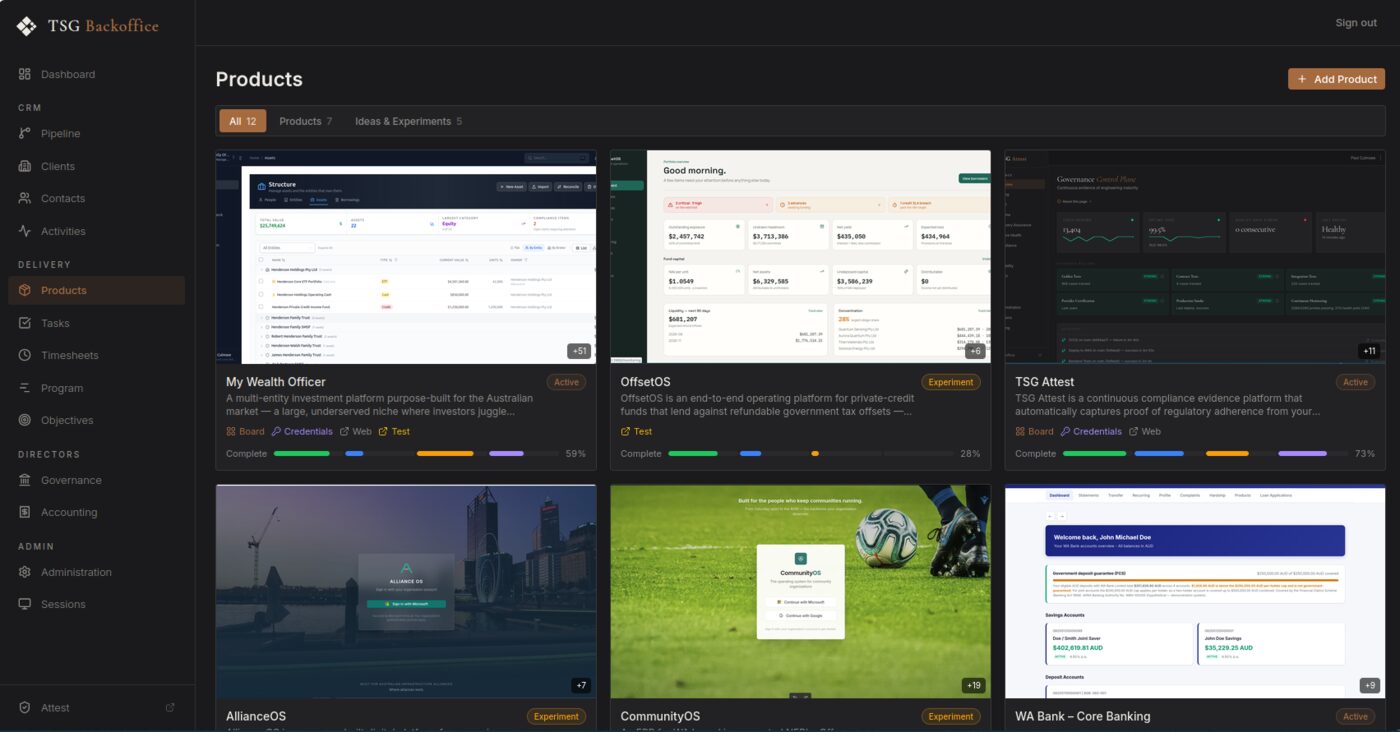
It started as a CRM. Pipeline, clients and contacts, then delivery, timesheets, objectives, governance and accounting. This is the screen where we run our product portfolio.
Buy versus Build Economics
We built our own CRM for almost nothing. The company trying to sell you one borrowed heavily, and now the bond market is repricing that bet. What happens to SaaS when financing gets expensive?
Read the full article →Good for whom?
Australia buys most of its enterprise software from overseas. Every licence renewal sends money offshore to pay for somebody else's margins, and the moat around that software is a large part of why the price keeps rising.
When AI makes building and switching cheap, more of that spend can stay here: with local teams who build, run and stand behind the systems, and with the organisations themselves, who keep the value they create.
As I want the red one! put it: buy local, partner local, hire local, keep the capital here. Not because local is virtuous, but because a moat you are standing in now is likely somebody else's.
There is an irony here, of course. The companies selling AI would very much like to be the next moat. That is why, in AI Is Approaching Its Proxy-Server Moment, we argued that you should never let a supplier control both the price of an activity and how much of it you consume. Draining one moat only to jump feet first into another is not progress.
A toe in the water...
With AI spend, most organisations are still in the first innings, trying to make sense of a crowded marketplace of vendors competing to become the next moat, each assuring you that the competitors down the road will lock you into one. One sells the smartest model, another the cheapest, another the platform that ties them all together, and every pitch wants you to move into its castle and stay.
It is hard to judge any of them without your own numbers, and most organisations don't have them. Add to that, there is no single right answer to where an organisation's tokens should run from anyway. Various things decide it.
- The organisation. A charity, a law firm and a bank have very different workloads, different obligations around cybersecurity and data sovereignty, and different appetites for speed and cost discipline.
- The environment. What none of them controls: how fast token prices fall, what hardware costs and how quickly it improves, what electricity costs, and what money costs now that it .
- The drivers. How fast AI activity grows, and how hard the organisation works at optimising it.
That inconvenient risk-free rate
Government bond yields are the starting price for money. When they rise, every other borrower pays more, and the cheap debt behind a lot of SaaS buyouts has to be refinanced at higher rates.
The same arithmetic applies to your own hardware. Buying the box means tying up capital, and capital now has a price.
Read the full article →Where the tokens should run is the product of all three. Change any one and the answer moves. No article can account for that, which is why we built you a calculator.
Moats and Waterlines
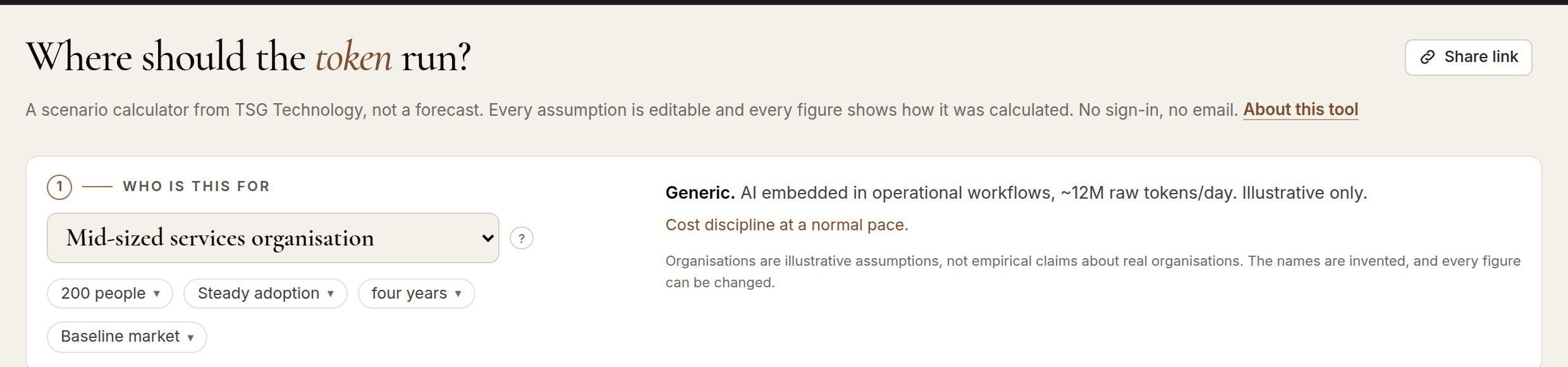
TSG Waterline is a free scenario calculator that asks one question: where should your tokens run? Pick a organisation, anything from a charity or a law firm to a hospital network, a local council or a retail bank. See what it uses AI for (document extraction, contract review, invoice processing, developer assistance), then watch its inference costs play out month by month for up to ten years, in the cloud or on hardware it owns or rents. Figures show in US or Australian dollars. It all runs in your browser: no sign-in, no email and no backend.
Illustrative, not empirical
Riverbend Community Care, Harbourline Bank and the rest do not exist. Each one is a set of assumptions about headcount, workloads and adoption, dressed up with a name so the scenario is easier to think about.
None of them is a claim about what a typical charity or bank actually spends. Every figure can be changed, and the point is that you change it to match your own organisation.
The month-by-month story runs in four stages of maturity. In practice the stages are not as clear cut as these, but the sequence is the mental model the calculator is built on.
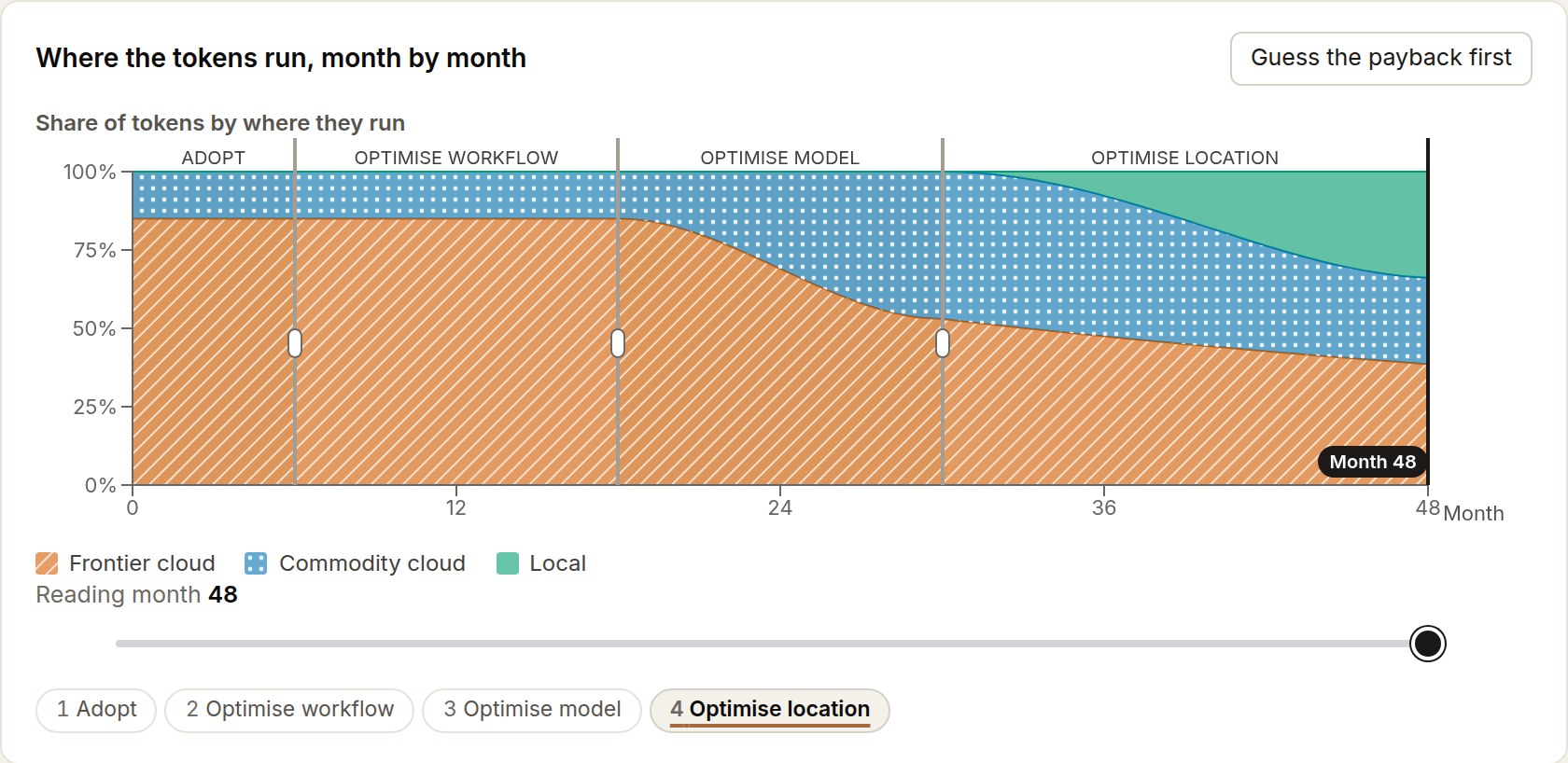
Three buckets and one ratio
- Internalhardware you control
- Commodity externalcheap cloud models
- Premium frontierthe best, at a multiple
Frontier intensity is the premium frontier bucket as a share of all organisational inference. The value capture article argued that the direction it moves will say more about the economics of AI than total consumption ever will.
AI Works. The Returns Might Not. →Built to Be Argued With
We wanted something practical that people could learn from, where you can see the evidence for yourself and weigh it alongside what vendors are telling you. If the numbers don't stack up for your organisation, the calculator should tell you so, even when that's not what we'd like to hear. That meant a handful of design decisions, and if you've read anything else on these pages, they'll sound familiar.
- Every figure shows its working. Every number has a "How is this calculated?" link, and the working comes from the calculation engine's own trace. The maths you are shown cannot disagree with the number on the screen, because they are the same calculation.
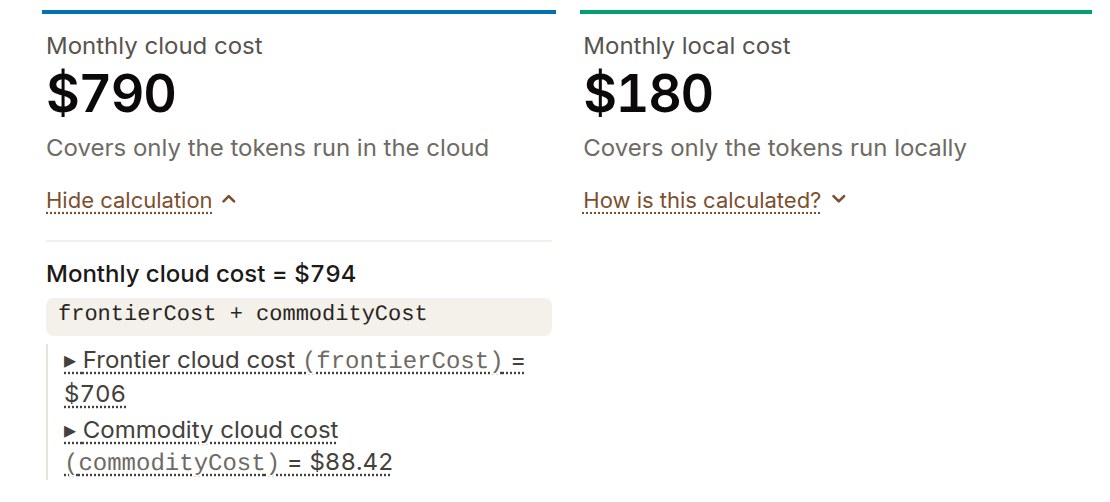
Open any figure and the working is right there, down to the formula. - Every assumption is editable, and dated. Cloud prices carry an "as of" date and are labelled as illustrative placeholders: put in what you actually pay. Hardware throughput is a deliberately conservative placeholder for the same reason. A calculator that hides its assumptions is just an opinion with a nicer interface.
- It tells you what moves the answer. Each major input is scaled from half to double and the whole scenario re-run, so you can see which assumptions matter and which you can stop arguing about.
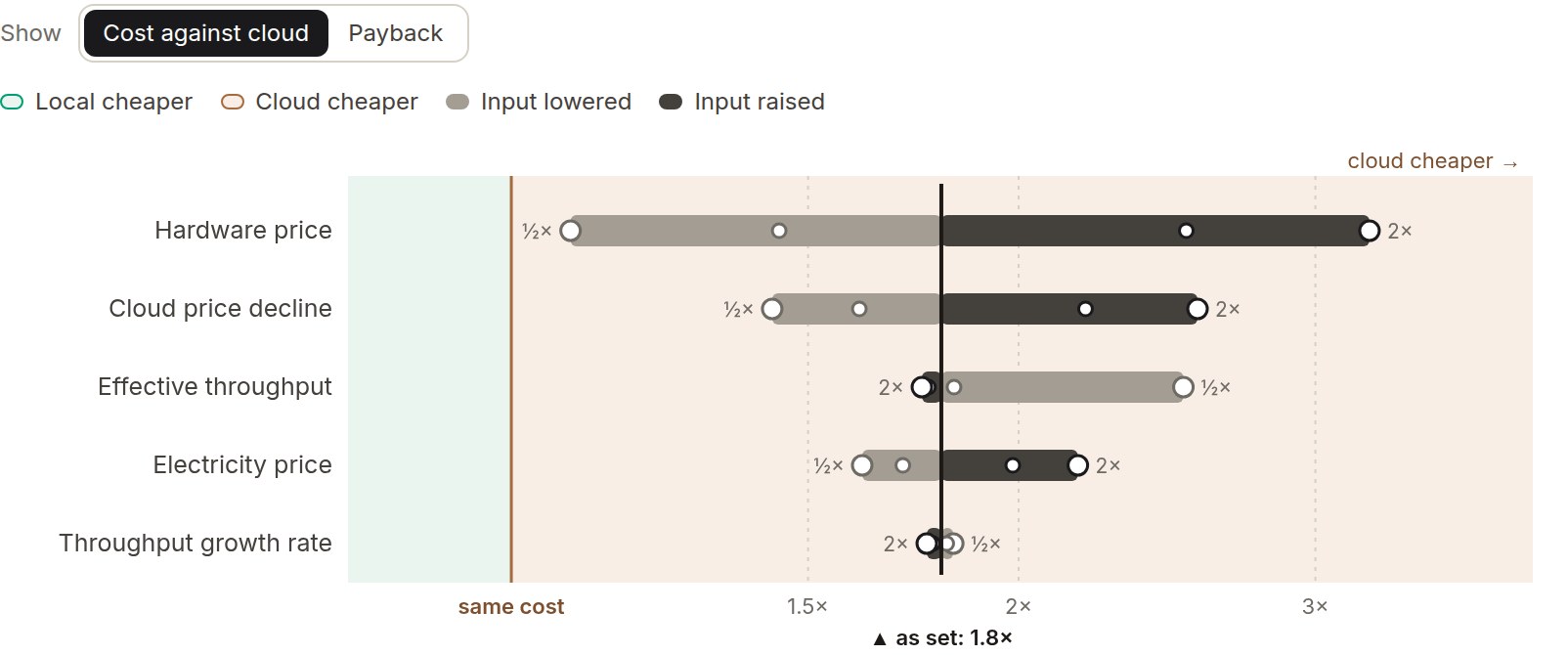
Each bar scales one input from half to double and re-runs the whole scenario. - Strategic value stays out of the money. Running inference yourself can be worth something beyond its cost: resilience to a cloud outage, offline operation, , latency, predictable capacity and bargaining power. The calculator lets you put a monthly value on each. Every one starts at zero, none of them enters a financial figure, and payback that counts them is shown separately and labelled as a non-financial estimate. A calculator that quietly adds them to the savings is manufacturing a return.
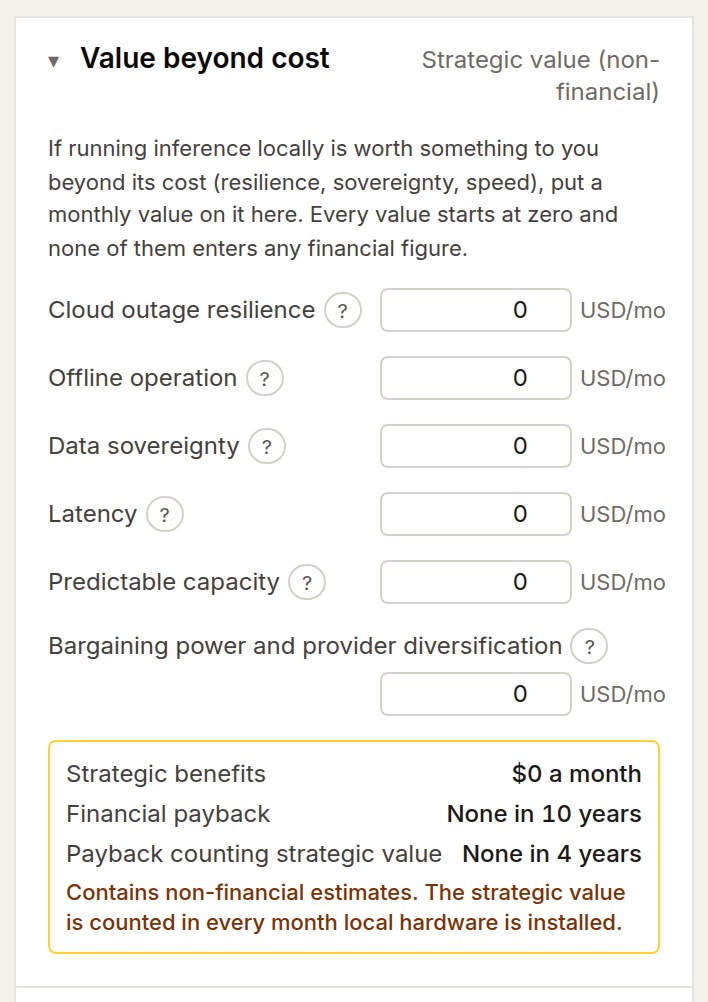
Every strategic value starts at zero and is reported separately from the money. - Money costs money. Hardware is a capital purchase, so the calculator includes a financing rate. As We Built a CRM. The Bond Market Will Finish the Job. put it, we live in an era of cheap software and expensive money, and both sides of that apply to whatever you put on a desk.
- Nothing leaves your browser. There is no account, no email capture and no telemetry. Your workload figures stay on your machine. If you want to talk to us, you know where we are.
Sometimes it is the whole reason
For a lot of the organisations we work with in regulated financial services, where data is processed is not a footnote. It can be a prudential expectation, a client commitment or a board decision, and it can outweigh the price per token completely.
That is exactly why the calculator keeps it separate. A real reason to run inference locally deserves to be argued as itself, not hidden inside a payback figure where nobody can see how much of the answer it is carrying.
Who It Is For
This calculator is for the same people we wrote I want the red one! for. In that article's words, AI decisions are "being taken right now, by people with a budget to manage and an outcome to deliver, and they add up."
It won't outsource your thinking and tell you what to buy, or predict where token prices may go next. It is a scenario calculator, not a forecasting tool. What it will tell you is what has to be true for a given answer to hold, and how far your assumptions are from that point. As we put it in Why This Company. Why Now., the purpose of governance "is to steer when you can't know all the variables." This is a steering instrument.
If you disagree with an assumption, good. We would much rather argue about an assumption than a conclusion. Change it, press Share link and send the scenario to us: the link carries every input you changed, so we will be looking at exactly what you were. Then tell us what we got wrong, what is missing, and what would make it more useful for your organisation.
This piece builds on arguments made earlier in AI Works. The Returns Might Not., AI Is Approaching Its Proxy-Server Moment and I want the red one! The calculator's default prices will change as the market does, and it shows the date they were set.